
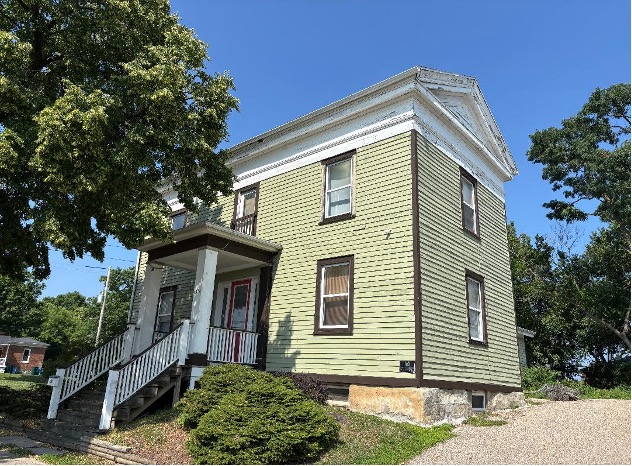
Nearly 180-Year-Old Lansing Home Gets a Second Life
FOR IMMEDIATE RELEASE
May 19, 2026
Stacy Esbrook, 517-334-0916
Bradly Rakowski, 517-719-8081
LANSING, MI — One of Lansing’s oldest surviving structures, a Greek Revival home built in 1847 at 1214 Center Street is being saved from deterioration and given a new future, just one block away. Michigan Community Capital (MCC) and new owners Bradly Rakowski and Chris Swope have partnered to relocate the historic Kilbourne-Mead House to 1314 Center Street, where it will be fully rehabilitated and returned to active use.
The move, expected to take place in June 2026, is a race against time. The home’s stacked fieldstone foundation is crumbling, with large stones having collapsed into the basement, standing water, and structural timbers compromised by decades of moisture, termites, and neglect. Without intervention now, the building will not survive.
“This house has stood in Lansing since before Lansing became Michigan’s permanent state capitol,” said Eric Hanna, president and CEO of Michigan Community Capital. “We are grateful to have found the right partners that will ensure this home continues to be a community asset in Lansing for generations to come.”
A House at the Center of Lansing’s Founding
The Kilbourne-Mead House is woven into the origin story of Lansing itself.
Built in 1847 during a sudden and dramatic building boom that followed the relocation of Michigan’s state capital to Lansing, the home was constructed for Joseph H. Kilbourne, the state senator who cast the last and decisive vote to make Lansing the capital. Kilbourne had been recruited by James Seymour, a wealthy New York banker and landowner who effectively founded Lansing, to serve as his land agent and oversee operations at the township’s only sawmill.
While 200 buildings went up rapidly around it, many crude and without proper amenities, the Kilbourne home was built to a different standard. A large, formal structure in the Greek Revival style, the architectural fashion of the era, it was designed to project prosperity and permanence in what had been, just months before, a dense wilderness with only a handful of log cabins.
By the 1850s, the home passed to James I. Mead, a dry goods merchant who became one of Lansing’s first elected aldermen and a prominent civic figure. The 1859 Ingham County plat confirms Mead’s ownership of the northwest corner of Block 5, Lot 12, the footprint of the house as it stands today.
A bird’s-eye rendering of Lansing from 1866 depicts the home clearly. The 1874 Atlas of Ingham County lists Mead as owner. The house has stood continuously for nearly 180 years.
How the Partnership Came Together
Michigan Community Capital, a Lansing-based nonprofit community development organization with deep roots in Old Town, acquired the Kilbourne-Mead home as part of its ongoing effort to stabilize and invest in the neighborhood in 2024. MCC owns additional parcels on Center Street and Liberty Street, acquiring properties as they became available over the past six years. MCC chose to strategically purchase troubled properties in the neighborhood to ensure they are held by owners committed to improving Old Town long-term.
In 2025, an unexpected conversation on Center Street sparked a new plan to save and restore the Kilbourne-Mean house. Bradly Rakowski, an Old Town business owner of Bradly’s Home and Garden, and local history enthusiast struck up a friendly conversation with Eric Hanna, president and CEO of Michigan Community Capital while Eric was checking on MCC’s properties. The two gentleman discussed Kilbourne-Mead’s history – the oldest standing structure in Lansing – and how the property has fallen into disrepair as it has changed ownership over the past 100+ years. Both Eric and Bradly expressed a strong desire to save and restore the building. Soon the conversation turned into a “what if” discussion and Bradly shared that he owned a parcel up the block on Center Street.
Eric and Bradly agreed on a preservation plan. Michigan Community Capital would sell the home to Bradly and his husband, Chris Swope, for $1. The home would be lifted and moved up the block to 1314 Center Street and Chris and Bradly would restore the home and convert it into a short-term rental (e.g. Airbnb), event space and community space. MCC would cover the cost of the move and Bradly and Chris would fund the restoration and new foundation costs.
“The home is an important part of Lansing and Michigan’s history. I love old homes, architecture, antiques and interior design,” said Bradly Rakowski. “To be able to save an historical home brings all those things into one collective passion. When we purchased our building at 319 E. Cesar E. Chavez for Bradly’s HG, the deal came with a vacant lot on Center Street, one block from where the Kilbourne-Mead house stands currently. At one time there was a pre-civil war home there but it was demolished many years ago. We had a space to move the home to, just seems like fate.”
How You Move a 179-Year-Old House
The move itself is a feat of specialized engineering. A professional house-moving company will carefully knock openings in the existing foundation and slide steel I-beams beneath the structure, creating a platform. Hydraulic jacks will lift the house off its foundation, wheels will be placed beneath the platform, and the entire structure will be pulled by truck down Center Street to its new location.
Once on site, the house will be temporarily supported above grade while crews construct a new foundation precisely fitted to the structure. The goal is to have the house lowered onto its permanent foundation within weeks of arrival. Both MCC and the new owners are highly motivated to complete that phase quickly, as the new foundation is what will fully stabilize the building.
Road impacts are expected to be limited. On the day of the move a cross section of Liberty Street and Center Street will be closed for a few hours. As well as the end section of Clinton Street, where the street dead ends into Center. The new location, 1314 Center Street, at the end of Clinton on Center.
What Happens Next — at 1314 Center Street and on the Block
Bradly and Chris plan to undertake a comprehensive rehabilitation of the home, with a commitment to preserving as much of the original historic fabric as possible. Bradly will be posting photos and videos of the home’s progress on Bradly’s HG Facebook page for the community to share. Once rehabilitated, the approximately 4,000 square foot home will have five bedrooms, three full bathrooms, open concept kitchen, separate living room and library spaces and basement utility room. The home will become an Airbnb, available for people to rent and enjoy. The property will also be open for community events and fundraising. At the rear of 1314 Center, a parcel that has been owned by the county’s Land Bank for more than a decade has been purchased by Bradly and Chris. It has now been incorporated into one large lot where the restored Kilbourne-Mead home will reside. With the extended rear yard, there will be opportunities to have outdoor events. The home will also be available for tours to share the home and history with the community.
“I do not feel that this home is owned by us, rather we are the stewardship to ensure the home is safe and available for many generations to come,” said Bradly Rakowski. “Restoring the home means we are saving an important part of our country’s history. Being able to share the finished home with the community is an incredible gift. The home is not planned to be a private residence so the community will be able to enjoy it and learn about Michigan and Lansing’s history. They will also be able to learn about historical architecture and construction.”
The lot at 1214 Center Street will be cleared, graded, and maintained as green space by MCC within a couple of weeks of the move.
As for the longer-term future of the block, MCC is taking a deliberate approach. “We’ve acquired these properties because we want to make sure they’re in responsible hands while we work through what’s possible,” said Eric Hanna. “Whatever we ultimately do here, we want to do it right — in partnership with the neighborhood and the Old Town Commercial Association — because what the block eventually becomes will be an asset to the community for decades to come.
About Michigan Community Capital
Michigan Community Capital is a 501(c)(3) nonprofit that exists to promote community and economic development, the creation of wealth and job opportunities; and to facilitate investment of private and public capital in Michigan. MCC is focused on driving economic mobility of low- and moderate-income Michigan residents and drives community development impacts in three key areas: Real Estate Development, CDFI lending, and New Markets Tax Credits. MCC is a U.S. Treasury certified Community Development Entity (CDE) and through its affiliate, Magnet Lending Corporation, a certified Community Development Financial Institution (CDFI). Since 2005, MCC has supported over $1.4 billion in project financing, successfully attracted $510 million in federal New Markets Tax Credits, and helped to create over 1,500 housing units and facilitated the creation and/or retention of over 5,000 high-quality, accessible jobs. Michigancommunitycapital.org.
About Bradly Rakowski and Chris Swope
Bradly Rakowski, originally from Muskegon, moved to Lansing after high school in 1984. He is the owner of two businesses in Old Town Lansing, Bradly’s HG and Birch Rak Clothier. Bradly Rakowski is a 1987 graduate of the Institute of Merchandising and Design, Lansing, with a Degree in Fashion Design and understudy in Interior Design.
In 1985, he got a job for Minor Creations, a lingerie manufacturer that was on the corner of Chavez and Turner. A time when Old Town had not yet been revitalized, Bradly felt a strong connection to the area. The old buildings and homes with historic architecture, a draw for the young aspiring designer.
“Old Town is home. It is a place I connect with and when I opened my shop, it was the only place I imagined being.” – Bradly Rakowski
Chris Swope, originally from Ypsilanti graduated from Michigan State University in 1985 and has lived in the area ever since. He moved to the City of Lansing in 2003 upon buying his first home. Chris is Lansing’s second longest serving City Clerk, first elected in 2005 and took office on January 1, 2006, and he serves in that role today. He is among the first openly gay elected city officials in the State of Michigan and has been serving the citizens of Lansing City ever since. Prior to serving the citizens of Lansing, Chris had a long and distinguished history of public service having served as an Ingham County Commissioner and worked in the Michigan House of Representatives and Michigan Senate.
In addition to being a small business owner, Chris serves the community in other capacities as a member of the Tri-County Regional Planning Commission, and the Lansing Rotary Club. He has served on the Boards of both the Eastside Neighborhood Organization and the Westside Neighborhood Association. He is a past President of the Lansing Association for Human Rights (LAHR). He has sat on the Board of the Lansing Branch American Civil Liberties Union (ACLU). He served two years as the Executive Director of Michigan Equality (now Equality Michigan), a statewide LGBTQ advocacy organization.
As a note of interest, in the summer of 1966, Chris’ parents moved a house from downtown Ypsilanti to the property where they lived in Ypsilanti Township. Following renovations, in the summer of 1967 his parents and five siblings moved into the house while his mother was several months pregnant with Chris.
###