
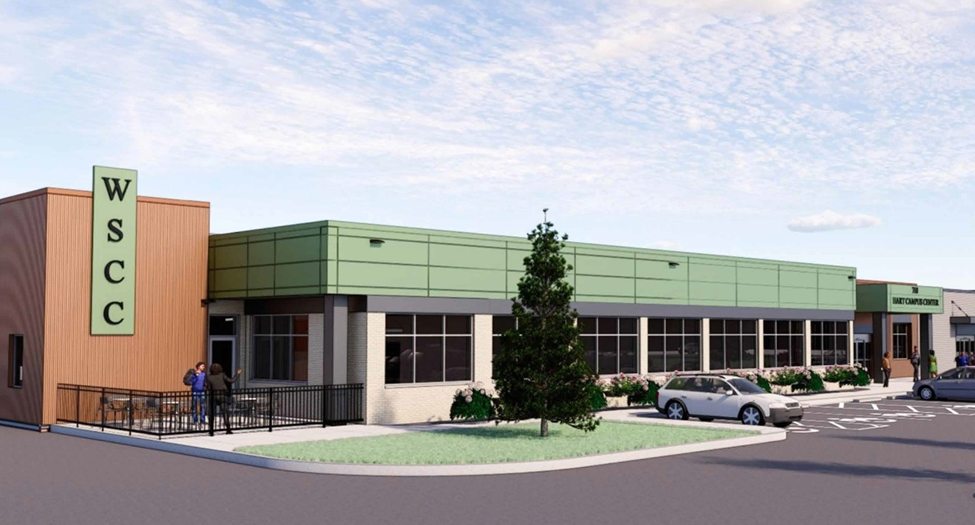
New community center in former grocery store will bring healthy food access, job training and wrap-around services under one roof in Hart
FOR IMMEDIATE RELEASE
February 19, 2026
LANSING, Mich. – Michigan Community Capital (MCC) is supporting the transformation of a former IGA grocery building in Hart into the West Shore Community College Oceana County Education Center, a multi-tenant facility designed to expand workforce training, healthy food access and essential services for low-income residents of Oceana County. MCC is providing $7.5 million in federal New Markets Tax Credit (NMTC) allocation.
West Shore Community College (WSCC), a public community college established in 1967, is acquiring and renovating approximately 25,000 square feet at 710 S. State Street into classroom, training and community service space. From this site, WSCC and partner organizations will deliver job training, career counseling, wrap-around services, and affordable healthy food options that respond directly to local needs identified in regional planning efforts.
“The West Shore community center will bring together education, workforce development, healthy food access and family-supportive services in one highly visible rural location,” said Eric Hanna, president and CEO of Michigan Community Capital. “With the use of NMTC allocation, MCC is helping West Shore Community College and its partners create a community anchor that supports economic mobility for residents who have historically had to travel long distances for services many communities take for granted.”
The project is located in a census tract that qualifies for NMTC based on a median family income at 77% of area median income and is designated “severely distressed” by the CDFI Fund due to its location in a non-metropolitan county. The project responds to a 2023 workforce development study that identified a need for more local training options and aligns with the 2025 City of Hart Master Plan goals to rehabilitate existing downtown infrastructure and create a vibrant hub of community activity.
At full operation, the West Shore Community College Oceana County Education Center will house the following tenants:
- Lakeshore Food Club – A nonprofit grocery store offering dignified, affordable access to healthy food for low-income families. The new Hart location is expected to serve approximately 1,800 low-income households annually using a membership model where all members are at or below 200% of the federal poverty level, with a modest monthly program membership fee that supports operations and helps sustain this choice-based approach. The site is in a USDA-designated low-income, low-access area, often referred to as a “food desert.”
- Michigan Works! West Central – A regional workforce development organization that will provide job search assistance, mock interviews, job fairs, resume support, and connections to employers in a new 6,000-square-foot space.
- Mid Michigan Community Action Agency (MMCAA) – A nonprofit offering wrap-around services such as utility assistance, weatherization support, USDA food boxes for seniors, housing counseling, housing stability services, and homebuyer support. MMCAA will relocate all Oceana County services from Shelby to the new hub.
- Stella’s Coffeehouse – A second location for an established community-focused café that will sell handcrafted drinks and pastries made with locally sourced ingredients and host community events such as game nights and gatherings.
Collectively, the project is expected to support at least 15 full-time positions, with roughly 80% of roles accessible without a four-year degree. Lakeshore Food Club will intentionally recruit from traditionally hard-to-employ populations, including local low-income residents, students in work-based learning programs, seniors seeking supplemental income, current members, and clients referred through Michigan Works!
“This center reflects West Shore Community College’s mission to provide accessible education and workforce training that strengthens our communities,” said Scott Ward, president of West Shore Community College. “By bringing learning, support services, and healthy food access together, we are expanding opportunity and addressing current needs in Oceana County.”
WSCC is providing the leverage funding for the NMTC transaction using its own balance sheet to bridge an array of state and local grants that the college has assembled for the project. PNC Bank is the NMTC investor.
“Supporting projects that expand economic opportunity is central to our mission,” said John Nunnery, senior vice president and manager of Tax Credit Originations at PNC Real Estate. “The West Shore Community Hub is the kind of place‑based investment that strengthens rural communities by bringing essential services, education and workforce resources together in one location. We are proud to partner with Michigan Community Capital and West Shore Community College to help make this project possible.”
Michigan Community Capital
Michigan Community Capital is a 501(c)(3) nonprofit that exists to promote community and economic development, the creation of wealth and job opportunities; and to facilitate investment of private and public capital in Michigan. MCC is focused on driving economic mobility of low- and moderate-income Michigan residents and drives community development impacts in three key areas: Real Estate Development, CDFI lending, and New Markets Tax Credits. MCC is a U.S. Treasury certified Community Development Entity (CDE) and through its affiliate, Magnet Lending Corporation, a certified Community Development Financial Institution (CDFI). Since 2005, MCC has supported over $1.4 billion in project financing, successfully attracted $510 million in federal New Markets Tax Credits, and helped to create over 1,500 housing units and facilitated the creation and/or retention of over 5,000 high-quality, accessible jobs. Michigancommunitycapital.org.
About PNC Bank
PNC Bank, National Association is a member of The PNC Financial Services Group, Inc. (NYSE: PNC). PNC is one of the largest diversified financial services institutions in the United States, organized around its customers and communities for strong relationships and local delivery of retail and business banking, including a full range of lending products; specialized services for corporations and government entities, including corporate banking, real estate finance and asset-based lending; and wealth management and asset management. For information about PNC, visit www.pnc.com.
###