Two national awards and one statewide award name Michigan Community Capital as recipient in May 2023
FOR IMMEDIATE RELEASE Thursday, June 1, 2023
LANSING, MICH. – May was a monumental month for Michigan Community Capital (MCC) who accepted three awards from two industry organizations. Two (2) New Markets Tax Credit (NMTC) investments led to receiving the Real Estate QLICI of the Year and Small Business QLICI of the Year designation from the 2023 Novogradac Journal of Tax Credits Community Development QLICIs of the Year. Additionally, MCC’s Lofts on Rowe development received the 2023 Tax Credit Award from the Michigan Historic Preservation Network (MHPN).
For 18 years, Michigan Community Capital (formally Michigan Magnet Fund) has invested in transformational community development projects across the state of Michigan that create housing, jobs and access to fresh food through NMTC allocations. Since the organization’s inception, MCC has worked to advance these projects using the best tools possible, even if it means creating new tools or wearing new hats.
Starting in 2018, MCC has taken its lending and investment know-how and began development of projects starting with Cadillac Lofts. As of today, nine (9) properties developed and/or co-developed by MCC has led to investing more than $89 million in Michigan communities, creating 421 new residential units and 68 new permanent jobs, and activating almost 350,000 square feet of indoor real estate.
Being a community development lender has helped Michigan Community Capital become a diligent and lean developer, and their development experience has also influenced their lending and investment approach.
“We are honored to be recognized by our partners and friends at MHPN, and proud to be recognized nationally by Novogradac Journal of Tax Credits,” said Eric Hanna, president and CEO of Michigan Community Capital. “The MCC team works very hard to deliver projects that communities need, whether as a lender, developer, investor, or insurer. We are grateful to both organizations for recognizing our work and the impact it has on the communities we serve.”
Lofts on Rowe in Ludington, Michigan
2023 Michigan Historic Preservation Network Tax Credit Award
Lofts on Rowe
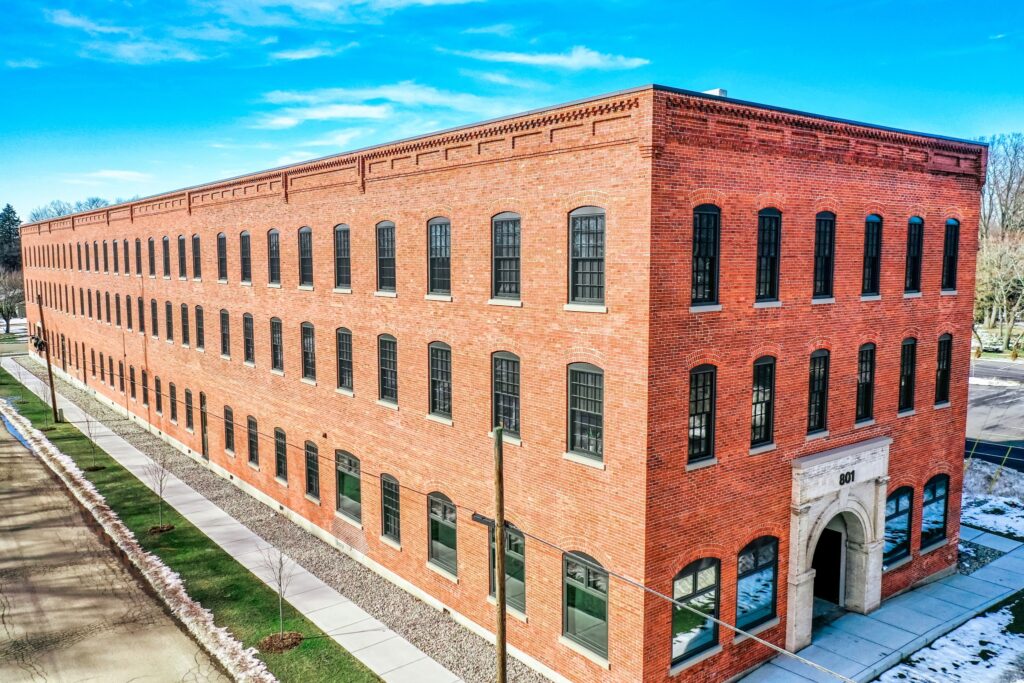
Michigan Community Capital’s development, Lofts on Rowe, was named the winner of a 2023 Tax Credit Award from the Michigan Historic Preservation Network (MHPN), and the award was presented in-person on Friday, May 12 at the 2023 MHPN Annual Conference on Mackinac Island.
After sitting vacant for nearly 30 years, the 1892-brick building fronting a full city block on the edge of a residential neighborhood just north of Ludington’s downtown was rehabilitated into 67 residential units. The building housed a series of manufacturing businesses, including Carrom wooden games and Haskell Canoe Company, and served as the headquarters for the Civilian Conservation Corps Camp Ludington in the 1930s.
The building’s industrial character is featured in the exposed interior brickwork and original wood beams. Amenities available to residents include a fitness room, bike storage, and on-site parking, and the ground level offers a commercial suite for local small businesses.
Utilizing historic tax credits, the $14-million project revitalized a long abandoned and neglected historic building in the heart of the neighborhood, giving the city and region a historic asset that will serve residents and community members for decades to come.
Michigan Community Capital served as the developer on the Lofts on Rowe project, and additional partners included Michigan Economic Development Corporation, Pennies from Heaven Foundation, PNC Bank, West Shore Bank, the City of Ludington and Mason County.
Two awards from the 2023 Novogradac Journal of Tax Credits Community Development QLICIs of the Year Awards named Michigan Community Capital.
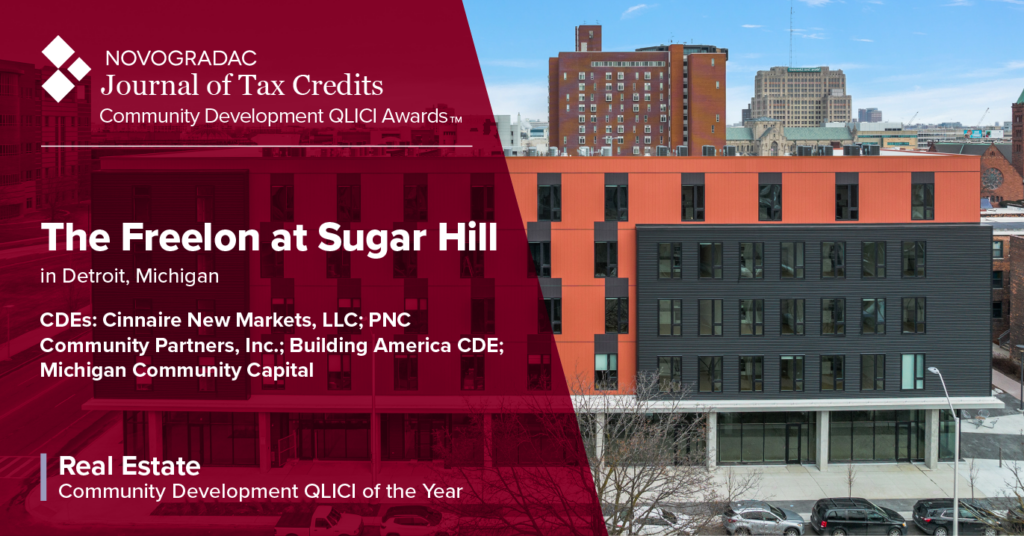
Real Estate QLICI of the Year
The Freelon at Sugar Hill
The Freelon at Sugar Hill is an inclusive community for all Detroiters, reinforcing urban vitality in Midtown Detroit’s Sugar Hill Arts District. The $35-million project co-developed by the Preservation of Affordable Housing (POAH) and Develop Detroit, replaced a vacant lot across the street from the John D. Dingell VA Medical Center with 68 apartments, 11,900 square feet of retail space, and a 160-space parking garage. Of the 20 affordable housing units, 14 were created for veterans served by the U.S. Department of Housing and Urban Development’s HUD-VASH program through the Dingell VA Center. Another six apartments are set aside for those earning up to 80 percent of area median income. The mixed-use building supports inclusive growth within the historic district as a cultural, commercial, and residential destination.
MCC provided $6 million in NMTC allocation in partnership with PNC Bank, Building America CDE, and Cinnaire.
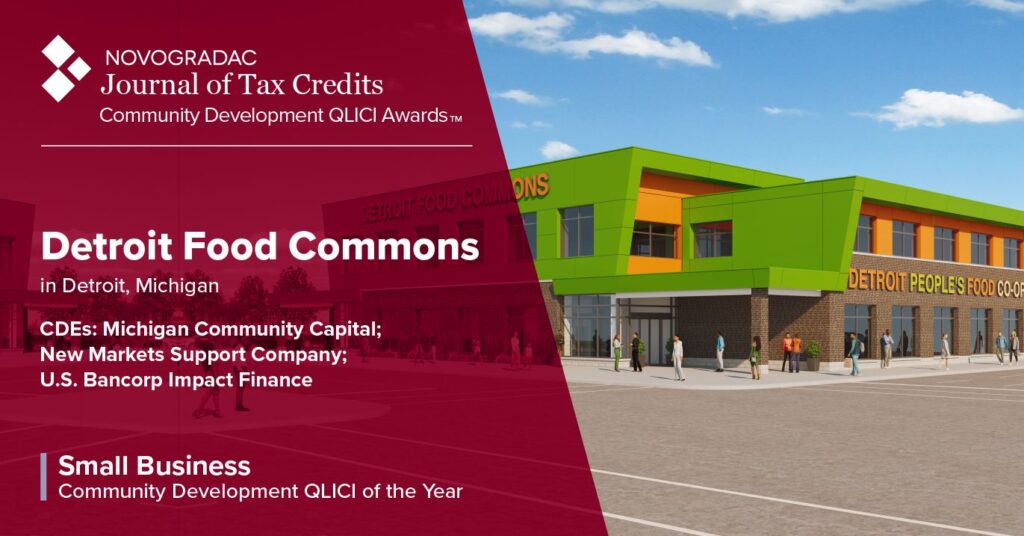
Small Business QLICI of the Year
Detroit Food Commons
The Detroit Food Commons is a new-construction development on the southeast corner of Woodward Avenue and Euclid Street in Detroit’s North End neighborhood. The two-story, 31,000-square-foot building will house the Detroit People’s Food Co-op – a community-owned grocery selling healthy, locally sourced food, a deli and bakery, and a neighborhood café – on the first floor. The second floor will house four teaching kitchens, a banquet hall/community meeting space and office spaces for nonprofit organizational use.
Located within a CDFI-qualified severely distressed census tract, the ground-level grocery will provide healthy, affordable options to more than 31,000 low–income community members and over 19,000 food desert residents within a 1.5-mile trade radius.
The nearly $20-million project spearheaded by non-profits Detroit Black Community Food Security Network (DBCFSN) and Develop Detroit (DDI) received $7 million in New Markets Tax Credits allocation from Michigan Community Capital in partnership with New Markets Support Company, and U.S. Bancorp Impact Finance.
The Novogradac Journal of Tax Credits Community Development QLICIs of the Year Awards recognize community development entities (CDEs) that made exceptional qualified low-income community investments (QLICIs) in the past year. The in-person award ceremony will be held at 9 am Eastern, Thursday, June 8, at the Fairmont Washington, D.C. Georgetown, during the Novogradac 2023 Spring New Markets Tax Credit Conference.
About Michigan Community Capital
Michigan Community Capital (MCC) is a non-profit diversified public-private partnership that supports the missions of the Michigan Economic Development Corporation (MEDC) and the Michigan State Housing Development Authority (MSHDA) by aggregating capital and facilitating the financing and development of low-income and attainable housing, and the redevelopment of complex brownfield sites within the State of Michigan. MCC is a U.S. Treasury certified Community Development Financial Institution (CDFI) and the only Community Development Entity (CDE) that deploys this resource solely throughout the entire State of Michigan. Over its 18-year history, MCC has supported over $1.2 billion in project financing, successfully attracted $380 million in federal New Markets Tax Credits, and helped to create over 1,350 housing units, 1.3 million square feet of commercial, retail and industrial space to facilitate job creation and expansion and insures over 22,000 affordable multifamily doors. MCC provides products in four key pillars: housing equity, bridge and gap lending, New Markets Tax Credits, and property insurance for Low-Income Housing Tax Credit projects.
###
FOR IMMEDIATE RELEASE April 28, 2023
Iron Mountain and Sturgis soon to welcome ALDI Grocery
LANSING, Mich. – ALDI Inc. is investing approximately $9.5 million to bring two new locations to rural communities in Michigan. A former Kroger location will be renovated at 811 S Centerville Road in Sturgis, and a new facility will be constructed at 2025 South Stephenson Avenue in Iron Mountain. Each store will be approximately 18,000 square feet and will feature a range of products including fresh meat and seafood, organic produce, and pantry essentials. The developments are being supported with a $7 million New Markets Tax Credit allocation from Michigan Community Capital.
ALDI Inc. is a leader in the supermarket retailing industry that offers discounted healthy groceries to customers in nearly 2,200 stores in 38 states. ALDI focuses on the groceries commonly purchased by shoppers, primarily under its exclusive brands, and is committed to providing customers with the highest quality products at the lowest possible prices. ALDI strives to reduce the company’s impact on the environment through energy efficient store design, including state-of-the-art lighting and refrigeration systems that have reduced energy features and environmentally friendly building materials.
ALDI will bring full-service grocery stores to Sturgis and Iron Mountain, both rural Michigan communities where increased affordable, fresh food is greatly needed due to high rates of food insecurity resulting from barriers to access (e.g., lack of transportation, rising food costs, etc.). Approximately 18 new full-time equivalent positions will be created to support the new stores. All positions will be accessible to individuals without a four-year degree and will pay a living wage.
“Michigan Community Capital is committed to leveraging our tools to bring healthy fresh food to underserved communities in Michigan,” said Eric Hanna, president and CEO at Michigan Community Capital. “Iron Mountain and Sturgis have both identified bringing more grocery options to their community as a high priority, and we are proud to partner with ALDI as they expand their footprint into Michigan rural markets.”
New Markets Tax Credits are a federal subsidy tool administered by the U.S Department of Treasury and designed to attract capital to projects that support low- and moderate-income households and communities. Michigan Community Capital (MCC) is the only Community Development Entity (CDE) that deploys this resource entirely in the state of Michigan. Since the organization’s formation in 2005, MCC has secured a total of $380 million dollars in tax credit allocation through competitive rounds to support Michigan businesses and communities. MCC uses NMTC’s to support job creation, access to healthy food, and mixed-use projects that include mixed-income housing and commercial businesses that benefit low-income households.
PNC Investment Partners is serving as the New Markets Tax Credit investor on this project.
Michigan Community Capital (MCC) is a non-profit diversified public-private partnership that supports the missions of the Michigan Economic Development Corporation (MEDC) and the Michigan State Housing Development Authority (MSHDA) by aggregating capital and facilitating the financing and development of low-income and attainable housing, and the redevelopment of complex brownfield sites within the State of Michigan. MCC is a U.S. Treasury certified Community Development Financial Institution (CDFI) and the only Community Development Entity (CDE) that deploys this resource solely throughout the entire State of Michigan. Over its 16-year history, MCC has supported over $1 billion in project financing, successfully attracted $320 million in federal New Markets Tax Credits, and helped to create over 750 housing units and 1.3 million square feet of commercial, retail and industrial space to facilitate job creation and expansion. MCC provides products in four key pillars: housing equity, bridge and gap lending, New Markets Tax Credits, and property insurance for Low-Income Housing Tax Credit projects.
###
FOR IMMEDIATE RELEASE April 27, 2023
Michigan Community Capital invests New Markets Tax Credits into multi-site development
LANSING, Mich. – Mel Trotter Ministries (MTM) and its subsidiary, Next Step of West Michigan, have been selected to receive New Markets Tax Credits (NMTC) from Michigan Community Capital (MCC), Chase, Consortium America, and Cinnaire. The tax credits will support a multi-site development which includes two buildings at the Next Step campus on Garden Street SE in Grand Rapids, as well as renovations at the MTM mission.
Mel Trotter will receive nearly $5.7 million toward its project goal to build a new 15,000-square-foot manufacturing training center in conjunction with a local manufacturer, as well as expand the existing training center and add workforce development apartments.
“We are extremely grateful for the assistance from MCC,” said Gordon Oosting, chief financial officer of Mel Trotter Ministries. “We often say that we cannot do this work alone, and this is one more testament to what can happen through muti-pronged involvement. The New Markets Tax Credits provide an important source of funds for investment in the areas we are serving.”
The project will help people living in poverty achieve economic stability through access to employment and complementary resources. The new 15,000-square-foot manufacturing facility will be located at 130 Garden Street SE in Grand Rapids. It will be utilized for construction and workforce development training. A section of the building will be leased to Jireh Metal Products, a minority-owned tier one supplier to furniture, automotive and hardware industries. It will include a job training program that will operate in conjunction with Next Step’s workforce development program. A two-story, 20,000-square-foot building, located at 101 Garden Street SE, will be renovated into a mixed-use facility with 10 transitional workforce housing units on the upper floor, and space on the first floor for Next Step of West Michigan’s skilled job training program, construction employment offices and community space.
MCC’s NMTC allocation also supported the recently completed renovation of Mel Trotter’s existing 47,000-square-foot facility located at 225 Commerce Avenue SW. The renovation and expansion of the mission includes 116 units of transitional housing, 400 emergency shelter beds with guest common areas, and dedicated space for supportive services to guests including a variety of healthcare services and social services.
“We are pleased to support Mel Trotter Ministries in expanding their footprint and vital services in Grand Rapids,” said Eric Hanna, president and CEO at Michigan Community Capital. “This is an exciting project because it not only supports Mel Trotter’s work meeting the immediate needs of those experiencing homelessness, but it also supports the transition out of poverty through job training and employment.”
Michigan Community Capital has allocated $8 million in New Markets Tax Credits to this project. Chase provided a $2 million NMTC allocation and is the NMTC equity investor for the project. These NMTC allocations, along with allocations from Consortium and Cinnaire, have provided a net benefit to Mel Trotter of approximately $5.7 million.
“We’re proud to support Mel Trotter Ministries and Next Step with an NMTC equity investment that will provide many essential services to the Grand Rapids community including quality jobs and job training, stable housing, and afterschool services to children in the area,” said En Jung Kim, managing director, Chase Community Development Banking. “Through our NMTC platform, we remain committed to using this impactful financing tool to support continued investment and economic development across Michigan and the US.”
Consortium America 100, LLC provided $8 million in NMTC allocation to the project.
“The Mel Trotter Ministries and Next Step project will have a tremendous impact in the Grand Rapids community, and Consortium America is thrilled to be a part of it,” said a representative from Consortium America. “During our almost 20-year involvement in the NMTC program, providing investment to distressed communities across the United States, this project really stands out due to the level of services offered and the path it provides to its program participants to escape the cycle of poverty.”
Cinnaire provided a $5-million NMTC allocation to the project.
“This multi-site development reflects the alchemy possible when mission-driven partners join forces to create extraordinary opportunities for vulnerable communities,” said Cinnaire Senior Vice President, Public Funding, Peter Giles. “Cinnaire’s NMTC investments are focused on transformative projects supporting equitable communities. This project will provide housing stability while expanding economic opportunities through job training and employment, critical components to putting those who need us most on the path towards a better future. Cinnaire is proud to join our CDFI partners to support Mel Trotter Ministries as they embark on this impactful journey.”
For more information on Mel Trotter Ministries visit meltrotter.org
About Michigan Community Capital
Michigan Community Capital (MCC) is a non-profit diversified public-private partnership that supports the missions of the Michigan Economic Development Corporation (MEDC) and the Michigan State Housing Development Authority (MSHDA) by aggregating capital and facilitating the financing and development of low-income and attainable housing, and the redevelopment of complex brownfield sites within the State of Michigan. MCC is a U.S. Treasury certified Community Development Financial Institution (CDFI) and the only Community Development Entity (CDE) that deploys this resource solely throughout the entire State of Michigan. Over its 16-year history, MCC has supported over $1 billion in project financing, successfully attracted $320 million in federal New Markets Tax Credits, and helped to create over 750 housing units and 1.3 million square feet of commercial, retail and industrial space to facilitate job creation and expansion. MCC provides products in four key pillars: housing equity, bridge and gap lending, New Markets Tax Credits, and property insurance for Low-Income Housing Tax Credit projects.