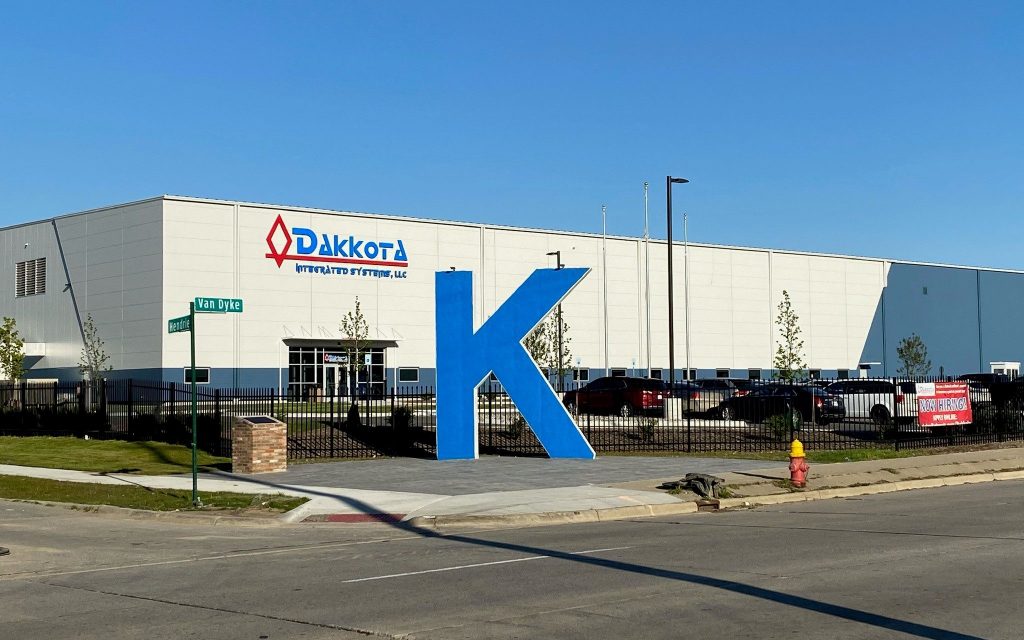
Michigan Community Capital supports Dakkota Integrated Systems’ $45-million manufacturing expansion with $8.3 million in New Market Tax Credits
FOR IMMEDIATE RELEASE
JULY 22, 2021
LANSING, Mich. – Dakkota Integrated Systems will continue facility expansions with assistance from a New Markets Tax Credit (NMTC) allocation from Michigan Community Capital (MCC). The project supports the complex assembly of the Instrument Panels for Stellantis Jeep Grand Cherokee at both the Detroit Assembly Complex Mack and Jefferson North Assembly, which are both locally built. The expansion, which started in 2020, will create 300,000 square feet of manufacturing space at the former site of Kettering High School.
The project will create 473 new full-time equivalent jobs in a census tract where 55.7% of the population falls below the poverty line. 446 of these jobs are accessible to people with less than a four-year degree. Benefits for these positions include health insurance, 401K contribution, paid vacation time, short- and long-term disability, job training tuition reimbursement, and education for personal finances, all of which will greatly benefit the families of these new workers.
“We are appreciative to Michigan Community Capital, the local community, Chase Bank and our other financial partners for supporting Dakkota’s expansion in Detroit,” said Gary Caldwell, Chief Financial Officer at Dakkota Integrated Systems. “The New Markets Tax Credit enhances our mission to create sustainable job opportunities in underrepresented communities for many years to come. It will allow us to achieve our goal of creating high-quality products for our customers at competitive pricing and profitability, which is critical to our success and allows us to achieve a winning environment for all.”
New Markets Tax Credits are a federal subsidy tool administered by the U.S Department of Treasury designed to attract capital to projects that support low- and moderate-income households and communities. MCC is the only Community Development Entity (CDE) that deploys this resource solely throughout the entire State of Michigan. Since the organization’s formation in 2004, MCC has secured a total of $255 million in tax credit allocation through competitive rounds to support Michigan businesses and communities. MCC uses NMTC’s to support job creation, access to healthy food, and mixed-use projects including mixed-income housing and commercial businesses that benefit low-income households.
“Dakkota Integrated Systems has continued to take its role as a corporate citizen very seriously, has been thoughtful about its compensation and hiring practices, and is truly demonstrating a commitment to ‘walking the walk’ by focusing on hiring Detroiters,” said Eric Hanna, President and CEO of Michigan Community Capital. “Those practices, which allow Detroiters to invest in themselves, are ultimately the key to giving the people of Detroit agency over their future. We could not be prouder of Dakkota, and we look forward to working with them and with companies like them in the future.”
Chase is investing $2,743,650 in New Markets Tax Credits into the project.
“We’re thrilled to work with Michigan Community Capital, Invest Detroit, and Dakkota Integrated Systems on their facility expansion, which will bring jobs to the Detroit community,” said James Simmons, Executive Director, Community Development Banking, Chase. “Through New Markets Tax Credit investments, we continue to support the building and revitalization of communities where we live and work.”
Invest Detroit is serving as a separate Community Development Entity in the project allocating $1,750,000 in New Markets Tax Credits.
“Invest Detroit’s mission is to support projects that create jobs and build a better future for all Detroiters,” said Senior Vice President of Lending, Marcia Ventura. “That’s why we are thrilled to partner with Michigan Community Capital, Chase Community Banking, the City of Detroit, the Michigan Economic Development Corporation, and Hunting Bank in a collaborative effort to bring this important project to Detroit. The Dakkota manufacturing facility is a job-creator for Detroiters. Partnering with Detroit at Work, they have already placed 109 city residents in full-time, high-quality positions. Collaboration makes these projects happen and is the key to a bright economic future for Detroit and our residents.”
About Dakkota Integrated Systems, LLC
Dakkota Integrated Systems was founded in 2001 to supply assembly and sequencing services for the original equipment manufacturer (OEM) automotive market. Specific products include suspensions, instrument panels, overhead systems, center consoles, cooling modules, bumper & grills, and general sequencing. The Company is headquartered in Michigan and has 14 operational locations, including out-of-state facilities in Ohio, Kentucky, Illinois, and Windsor, ON. The Company excels at providing “just-in-time” products to support auto manufacturing. Various levels of technology are employed including automation, robotics, scanning and sophisticated data collection with analysis in order to provide a high level of repetitive quality and integrity of the Company’s products/services. This has allowed the Company to continue to grow and support the livelihood of its more than 1,000 Michigan employees and more than 2,350 team members worldwide
About Michigan Community Capital
Michigan Community Capital (MCC) is a non-profit diversified Public Private Partnership that supports the mission of the Michigan Economic Development Corporation (MEDC) and the Michigan State Housing Development Authority (MSHDA) by aggregating capital and facilitating the financing and development of low-income and attainable housing and the redevelopment of complex brownfield sites within the State of Michigan. MCC is a US Treasury certified Community Development Financial Institution (CDFI) and a certified Community Development Entity (CDE). MCC has successfully attracted federal New Markets Tax Credits, supported over $900 million in project financing and helped to create over 750 housing units and over 950,000-square-feet of commercial, retail and industrial space to facilitate job creation and expansion. MCC provides products in four key pillars: housing equity, bridge and gap lending, New Markets Tax Credits and property insurance for Low Income Housing Tax Credit projects. For more information on MCC visit michigancommunitycapital.org.
###
FOR IMMEDIATE RELEASE
MAY 17, 2021
LANSING , Mich. – Grand Haven’s newest neighborhood in the city limits broke ground earlier this month. The 30 single-family home development named Robinson Landing, will address an identified housing need by offering new construction homes priced from $139,900 to $279,900.
“This project is responding to a housing crisis we are seeing across the state,” said Marilyn Crowley, Vice President of Investment for Michigan Community Capital. “With construction prices skyrocketing and a large number of buyers, we are seeing a shortage of housing that is priced affordably for the majority of Michigan’s workforce. It took many partners to bring this project together, and we’re excited to see the result come to life.”
Housing Next, an Ottawa County based non-profit and housing advocate, commissioned a housing study in December of 2018 that identified moderately priced housing as a high-level need in Ottawa County. The report outlines significant growth in households earning an annual income between $40,000 and $74,000 that outpaces the housing supply.
“We are pleased to provide support for a project that is breaking down barriers to housing affordability and availability,” Housing Next Executive Director Ryan Kilpatrick said. “This innovative and transformative project – with owner-occupied units priced below $180,000 – is exactly what we need right now to help solve our region’s workforce housing crunch. Our communities have greater economic prosperity and job growth when families can find affordable housing.”
Formerly owned by the City of Grand Haven, the 7.5-acre parcel on Comstock Street will allow residents easy access to downtown. The project site was transferred from the City to the Ottawa County Land Bank in November 2020. Michigan Community Capital purchased the land at a reduced price of $32,000 earlier this year to encourage affordability of the neighborhood development.
“This project is a model for non-profit/governmental cooperation,” said Pat McGinnis, City Manager of City of Grand Haven. “When we all put our full toolbox into play, we can create attainable workforce housing in Ottawa County. The Brownfield Redevelopment Authority, Housing Next, Ottawa County, BlueWest Properties, Michigan Community Capital, Ottawa County Land Bank, Grand Haven Charter Township and the City of Grand Haven all put this on the front burner and made it a reality. There’s surely more to come.”
The project will cost $7.5 million over two phases. Last year, the Grand Haven Area Community Foundation approved a $1.5 million low-interest investment in MCC to encourage the creation of middle-income housing in Northwest Ottawa County.
“Solving the workforce housing crisis takes innovative thinking, and we believe this partnership with MCC is a key step to getting there,” said Hadley Streng, President of the Grand Haven Area Community Foundation. “We’ve been focused on supporting housing solutions for all income levels in our community for years, and it’s why we helped co-found Housing Next in 2017. We’re inspired by the collaboration of our partner organizations throughout Ottawa County that have brought us to this point.”
16 of the 30 homes in Robinson Landing will be in the Grand Haven Area Community Land Trust (CLT) program which is a shared-equity program allowing for lower home prices because the buyer is purchasing the home, not the land. The CLT retains ownership of the land and enters into a 99-year ground lease with the homeowner. The Grand Haven Area Community Land Trust was created by the City of Grand Haven and is managed by the Neighborhood Housing Services team.
“Neighborhood Housing Services is thrilled to be spearheading the creation of the Grand Haven Area Community Land Trust,” said Rhonda Kleyn, Neighborhood Housing Services Development Coordinator. “The organizing committee has been working for months to create an amazing program for this area. This type of shared equity homeownership program results in the purchase price being more affordable because the purchaser is only buying the home, not the land. The land will be leased from the CLT at a very low monthly cost. It’s likely the potential CLT buyers already rent or work in Grand Haven, and we are excited to work with them to purchase an affordable, newly built home. “
Homes in this program have income restrictions for buyers that target households with incomes between 60 and 80 percent of the area median income (AMI determined by Michigan State Housing Development Authority). Homes in the CLT program are priced at $139,900 for a 2-bedroom, 1-bathroom home; $159,900 for a 3-bedroom, 2-bathroom, home; and $179,900 for a 3-bedroom, 2.5-bathroom, two-story home. More detailed information about the homes offered and CLT program can be found at robinsonlandingmi.com.
The remaining 14 homes are not on a ground lease, do not have income restrictions and are considered as market-rate homes. These market-rate homes are priced at $239,900 for a 3-bedroom, 2-bathroom, ranch-style home; and $279,900 for a 3-bedroom, 2-bathroom, two-story home.
Built by The DK Design Group, all 30 homes will have identical high-quality finishes and construction that is slab-on-grade with wood-frame, stick-built framing. Stainless steel GE appliances are included in the sale price – a value of over $5,000 that includes a gas stove, dishwasher, garbage disposal, microwave, refrigerator, washer, and dryer.
Homeowners purchasing prior to the home’s construction deadline will be able to choose finishes from pre-selected options. These finish choices include cabinetry, countertops, flooring, and the exterior package with siding, stone veneer, entry door color, and asphalt shingles.
The project will be constructed in a two-phase process. The first phase will span 16 months and consist of site preparation and infrastructure to serve the entire site, as well as the construction of 15 homes. 8 of the 15 homes in the first phase will be in the Community Land Trust program. Once 75% of the homes in Phase I are sold, Phase II will begin.
BlueWest Properties, a West Michigan brokerage, is serving as the listing real estate company in the sale of the homes. Driven philanthropically to serve their community, the owner/broker has agreed to a reduced commission allowing home prices to remain low for buyers.
“The BlueWest Properties team is grateful to have been chosen to represent the City of Grand Haven’s first Community Land Trust development,” said Meghan Heritage, Owner and Broker at BlueWest Properties. “We know that affordable housing is a paramount part of a successful community, and as our company tagline states, ‘Better Real Estate for a Better Community.’ We are excited to once again put our hands to work to benefit the community.”
For more information about this project and homes offered, please visit robinsonlandingmi.com.
Michigan Community Capital (MCC) is a non-profit diversified Public Private Partnership that supports the mission of the Michigan Economic Development Corporation (MEDC) and the Michigan State Housing Development Authority (MSHDA) by aggregating capital and facilitating the financing and development of low-income and attainable housing and the redevelopment of complex brownfield sites within the State of Michigan. MCC is a US Treasury certified Community Development Financial Institution (CDFI) and a certified Community Development Entity (CDE). MCC has successfully attracted federal New Market Tax Credits, supported over $900 million in project financing and helped to create over 750 housing units and over 950,000-square-feet of commercial, retail and industrial space to facilitate job creation and expansion. MCC provides products in four key pillars: housing equity, bridge and gap lending, New Market Tax Credits and property insurance for Low Income Housing Tax Credit projects. For more information on MCC visit michigancommunitycapital.org.
###
FOR IMMEDIATE RELEASE
MAY 5, 2021
LANSING , Mich. – In the middle of a charming neighborhood in Ludington, a massive brick building has sat vacant at 801 North Rowe Street for many years. Built in 1892, it is a physical monument to the manufacturing legacy of the region. The building begins a new chapter this week, as construction starts on a $14-million renovation.
Several years in the making, the project will convert the 45,000-square-foot, open factory space into 65 stylish apartments and 750 square feet of commercial space. The apartments will have high ceilings; large, arched, historic windows; granite countertops; stainless steel appliances; and will retain many of the unique characteristics of this 129-year-old building.
“This project has been a labor of love,” said Marilyn Crowley of Michigan Community Capital, the project developer. “We can’t wait to see new life come to this important historic building. This project would not have been possible without the significant support from the community.”
As early as 1904, the building housed a variety of wood-based product manufacturing such as typeset for printing presses, a popular board game Carrom, and a revolutionary product called Haskelite invented by a Ludington local, Henry Haskell. This waterproof, moldable plywood product was used in making canoes, automobile and bus roofs, airplanes and other modern products of the 1920s. The building’s manufacturing history qualified the property to be listed on the National Register of Historic Places.
The old, yet sturdy exterior will contrast beautifully with modern building amenities including an elevator, electronic key access, building-wide security cameras, community room and fitness room with free wi-fi, in-unit washer/dryers and energy efficient appliances.
“This is an exciting moment that belongs to our community,” said Monica Schuyler from the Pennies from Heaven Foundation. “As a community, we all worked to support this effort to revitalize this beautiful and unique piece of our history to become a beautiful place to live, meeting a huge need in our region, and continuing this building’s legacy for years to come. I could not be prouder of our community.”
The Pennies from Heaven Foundation has been a significant supporter and funder of the project. The organization provided $1 million of grant money specifically for creation of middle-income housing units and neighborhood revitalization.
Local couple, Ron and Dawn Sarto, also supported the goal of creating housing by donating the property to Michigan Community Capital in 2019.
“The City of Ludington is grateful to everyone involved from the beginning of this project. Adding more housing units has been a long-standing need, not just in Ludington, but throughout the county,” said the honorable Steve Miller, Mayor of the City of Ludington. “We’re very much looking forward to seeing the completion of this project and the others that will be following, as they signal positive growth in our community.”
The City of Ludington approved an Obsolete Property Rehabilitation Abatement as well as an adaptive reuse ordinance to encourage this historic redevelopment. In addition, the City sold the property adjacent to the development and will relocate their maintenance and storage barns to provide room for resident parking.
The Mason County Board of Commissioners and the City of Ludington approved a brownfield plan that will reimburse the project for brownfield-eligible activities, such as lead and asbestos abatement and installation of a vapor mitigation system. This has helped offset the cost of redeveloping the vacant, functionally obsolete, blighted property. This plan was supported by the Michigan Department of Environment, Great Lakes, and Energy (EGLE) as well as the Michigan Economic Development Corporation (MEDC).
The Michigan Strategic Fund approved a $2-million Community Development Block Grant to eliminate blight through historic preservation, as well as Ludington’s first federal historic tax credit coordinated by the Michigan State Office of Historic Preservation.
“The Lofts on Rowe project is rehabilitating the historically significant former Haskell Manufacturing Company Building into a unique and vibrant year-round affordable housing option for key segments of the workforce in Ludington,” said Michele Wildman, Senior Vice President of Community Development at the Michigan Economic Development Corporation. “The MEDC is committed to supporting transformative projects that honor our history and help create vibrant, resilient communities, while supporting our strong economic recovery statewide. We are pleased to collaborate with Michigan Community Capital and our local partners on this project, which will help make Ludington an even more attractive place to live, work, visit, and play.”
The historic designation of the property allows for access of federal historic tax credits for 20 percent of the rehabilitation costs. PNC Bank is the tax credit investor for this project.
“PNC Bank is proud to help revitalize this historic building,” said Sean Welsh, PNC Regional President for West Michigan. “This project is consistent with PNC’s long-term support of neighborhood revitalization, education and economic development in the communities we serve.”
Westshore Bank is funding the project with a $6.3-million loan as well as bridge loans for the Community Development Block Grant and the historic tax credit. It was important to this local bank to support housing in the region.
“We are excited about what Lofts on Rowe means for the Ludington area,” said Bobby Fisher, Vice-President-Commercial Loan Officer at Westshore Bank. “Recognition needs to be given to Michigan Community Capital and the City of Ludington for seeing and executing the vision for this project. We are truly grateful to be a part of it and look forward to seeing its impact.”
“MCC is thrilled to be part of a huge effort by this community to bring in badly needed housing for year-round residents working in Ludington and to save this great historic resource for generations to come,” said Eric Hanna, President and CEO of Michigan Community Capital. “This project organically evolved from partnerships with local stakeholders and business owners with the city, county, state, federal historic tax credits and even local community banks; everyone seemed to align to overcome lots of obstacles and solve problems. After over a year of work, it’s so satisfying to watch the project moving forward.”
Residential leasing for Lofts on Rowe is anticipated to begin in spring 2023. Apartments will be priced between $750 and $1,300 per month with studio, one-bedroom, two-bedroom and three-bedroom units available.
For more information about this project, apartments or leasing the commercial space, and to view the project’s groundbreaking video, please visit loftsonrowe.com.
Michigan Community Capital (MCC) is a non-profit diversified Public Private Partnership that supports the mission of the Michigan Economic Development Corporation (MEDC) and the Michigan State Housing Development Authority (MSHDA) by aggregating capital and facilitating the financing and development of low-income and attainable housing and the redevelopment of complex brownfield sites within the State of Michigan. MCC is a US Treasury certified Community Development Financial Institution (CDFI) and a certified Community Development Entity (CDE). MCC has successfully attracted federal New Market Tax Credits, supported over $900 million in project financing and helped to create over 750 housing units and over 950,000-square-feet of commercial, retail and industrial space to facilitate job creation and expansion. MCC provides products in four key pillars: housing equity, bridge and gap lending, New Market Tax Credits and property insurance for Low Income Housing Tax Credit projects. For more information on MCC visit michigancommunitycapital.org.